
Solutions
Scripture drafting for languages the big tools skip, with the evidence attached to every verse.
Logos Canon drafts Scripture in a low-resource language from that language's own published corpus, then puts each verse through an independent trust pipeline before a mother-tongue reviewer ever sees it. The reviewer stays the final word. What changes is that they start from evidence instead of from scratch.
Watch the walkthrough
Five minutes: a chapter drafted, checked, reviewed and reported, exactly as a team sees it. The sections below go through each stage.
What Logos Canon is
A drafting and checking platform for Bible translation teams working in ethnic and minority languages. Three things, in one place.
Draft
One verse at a time, taught by the most relevant verse pairs from the language's own published translation, so the draft carries the team's orthography, names and style rather than a generic imitation. Three candidates are drafted and an independent check picks the winner.
Check
Every verse is back-translated by a separate model that never sees the source, scored against the gateway text, checked against the Greek or Hebrew, and screened for key-term consistency and readability. Flags quote the exact words at issue.
Review and certify
Reviewers approve, correct or reject verse by verse, online or from an offline packet. Confirmed books can earn a bounded statistical claim about their error rate, issued only after human adjudication.
The part that matters
How quality is built in, not bolted on
Generation and judgment never share evidence. The drafter sees helps the judges never see; the judges see originals the drafter is never trusted to have used correctly. Every number on a report is computed from quoted flags by fixed weights, and the judges themselves are measured with planted errors before they are trusted.
Retrieval-taught drafting, best of three
Candidates vary only in which example pairs teach them. A back-translation and adequacy check selects the winner; the original-language consultant plays no part in selection and judges the result later.
Vocabulary pass, measured against the team's own verses
A draft that uses words uncommon in the team's corpus is translated again with those words pointed out. The new version is back-translated and gated like any other candidate and is rejected if it adds a critical flag, adds a major flag, or drops fidelity by more than ten points. In the trial that shipped it, drafts closed three quarters of the readability gap to the team's own verses with no loss against the Greek. Each touched verse carries a trail: before, after, which words, both scores.
Independent back-translation, the witness
A separate model renders the draft back into the gateway language in clinical literal mode without ever seeing the source verse. An anti-recitation rule stops it from remembering the famous verse instead of reading the words in front of it. If the model declines or returns nothing, the verse is marked unchecked rather than passed.
Computed verdicts, never opinions
Deterministic safety nets run first: digit and name parity, length ratio, repetition. Then a judge emits severity-graded flags quoting the exact wording at issue, and the 0 to 100 score is computed from those flags. The model is never allowed to assert a number.
Original-language consultant
Every verse is checked against the Greek New Testament or Hebrew Old Testament directly, with word-level scholarly data: lemma, morphology, sense domains, clause roles, resolved referents. Known manuscript-tradition variants are never flagged as errors, and inherited gateway readings are distinguished from draft errors.
Second witness on serious flags
A verse with a major flag gets a second, corpus-blind back-translation from deliberately different conditioning. Two witnesses that share a bias are one witness.
Key terms and textual basis
Approved key-term renderings are enforced in drafting and checked for consistency afterwards. Where the gateway and the critical text differ, the textual basis of a passage is analysed so a tradition decision is made knowingly, not counted as a mistake.
Human review, then certification
Mother-tongue reviewers approve, correct or reject verse by verse with plain-language guidance per verse and a consultant report after every re-check. A confirmed book can earn a bounded statistical claim, at most X percent of verses carrying a meaning-changing error at 95 percent confidence, by the acceptance-sampling method used in WHO field surveys.
Marked because we have not seen another tool do it
What we have not seen anywhere else
These are the parts of Logos Canon we have looked for in other Scripture drafting and checking tools and not found. If you know of one that does any of these at the verse level, we would like to hear it.
Judges that are themselves measured
Every automated check is fed planted known-answer errors and known-clean verses. The catch rates and false-alarm rates are printed on every report and can be re-run from the dashboard after any change.
Reviewers that are themselves measured
A reviewer occasionally meets one planted, plausibly wrong verse. Whether they catch it is recorded, so a certificate rests on reviewers whose attention has been tested, not assumed. The planted text never enters the stored translation.
Verse-level audit of a published translation
Upload a translation your team already published and every verse is scored against the original languages, with nothing machine-filled and versification differences realigned. How good is the Luke we already have, answered per verse.
Inherited versus introduced
Where your text follows the gateway but the gateway departs from the Greek, the report says so. A tradition decision is never counted as your error.
Statistical certification
A bounded claim about a book's error rate, issued only from human adjudication of a statistically valid sample, with the method and the numbers on the certificate.
Readability against the team's own writing
Not a generic reading-level score: how a draft reads compared with the verses this team writes by hand, using this language's corpus. It is what found the vocabulary gap above and what measured the fix.
Reading a book's numbers
Every book page carries a quality overview: one row per chapter, the same numbers as the printable book report, computed by the same code. Every count is a door: click it and the verses behind it open.
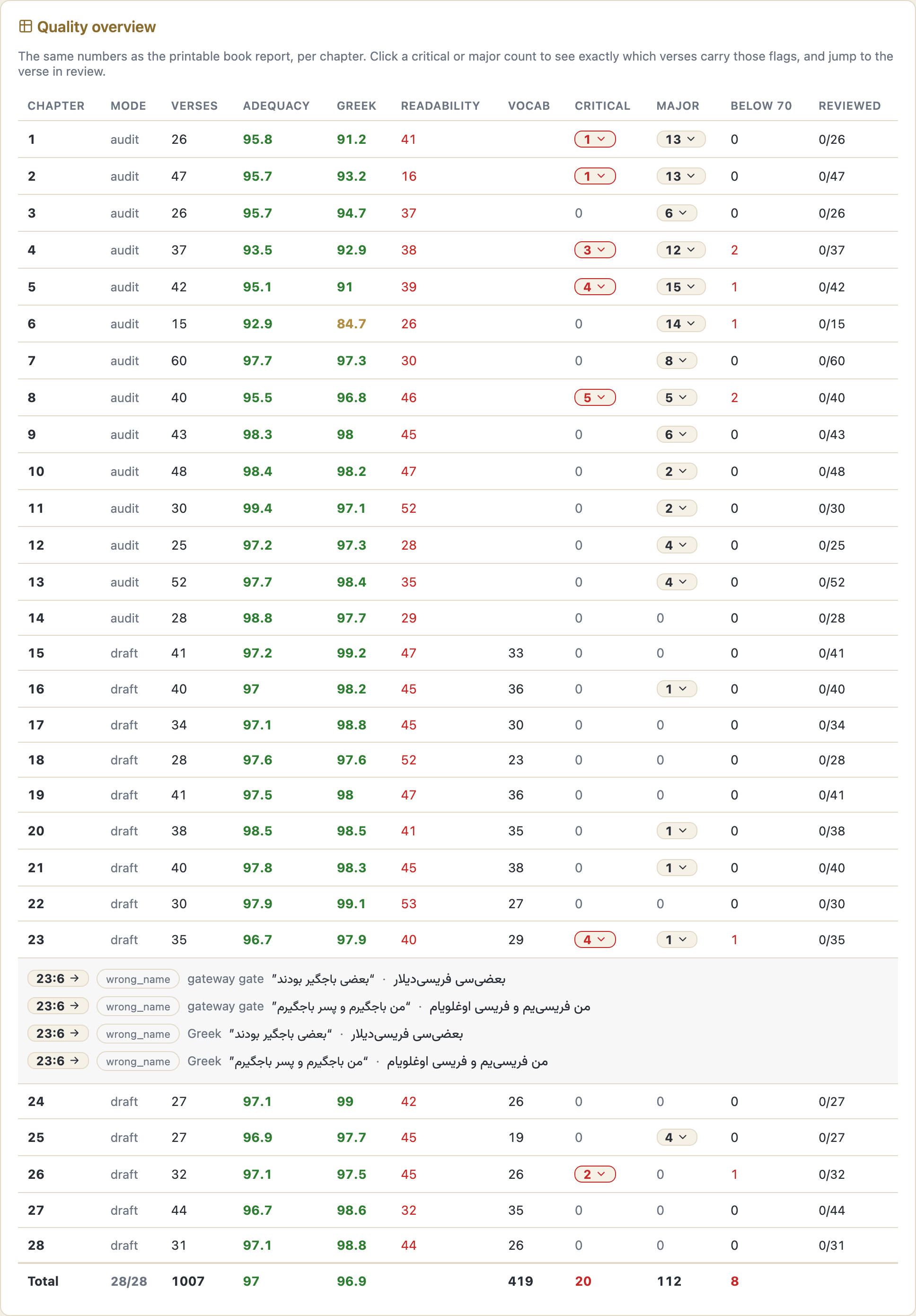
Acts in one team's project: the human chapters 1 to 14 were audited, chapters 15 to 28 were machine drafted, and chapter 23's four critical flags are opened to the verses that carry them.
Adequacy
How faithfully the verse carries the gateway text, judged from an independent back-translation and computed from severity-weighted flags. 100 means no flag at all.
Greek or Hebrew
The original-language consultant's score for the same verses, judged against the Greek New Testament or Hebrew Old Testament with word-level scholarly data. A gap between this column and Adequacy usually means the gateway itself departs from the original there.
Readability
Corpus-relative, not a generic reading level: a word counts as difficult when this team's own published text uses it rarely, and long sentences cost points. Compare chapters of the same language with it; do not compare languages. It rises by itself as the team's corpus grows.
Vocab
How many verses the vocabulary pass re-translated toward the team's everyday wording and kept after an independent re-check. Each such verse carries its before-and-after trail.
Critical and Major
Flags that change meaning. Critical touches doctrine, a name of God or Jesus, or missing content; major changes or loses part of the verse. Click the count: each flag shows its verse, which gate raised it, the quoted words, and a jump into review that lands on that verse.
Below 70 and Reviewed
Verses whose adequacy fell under 70 need a human first. Reviewed counts approved or corrected verses against the chapter total; a lock means the chapter's text is confirmed.
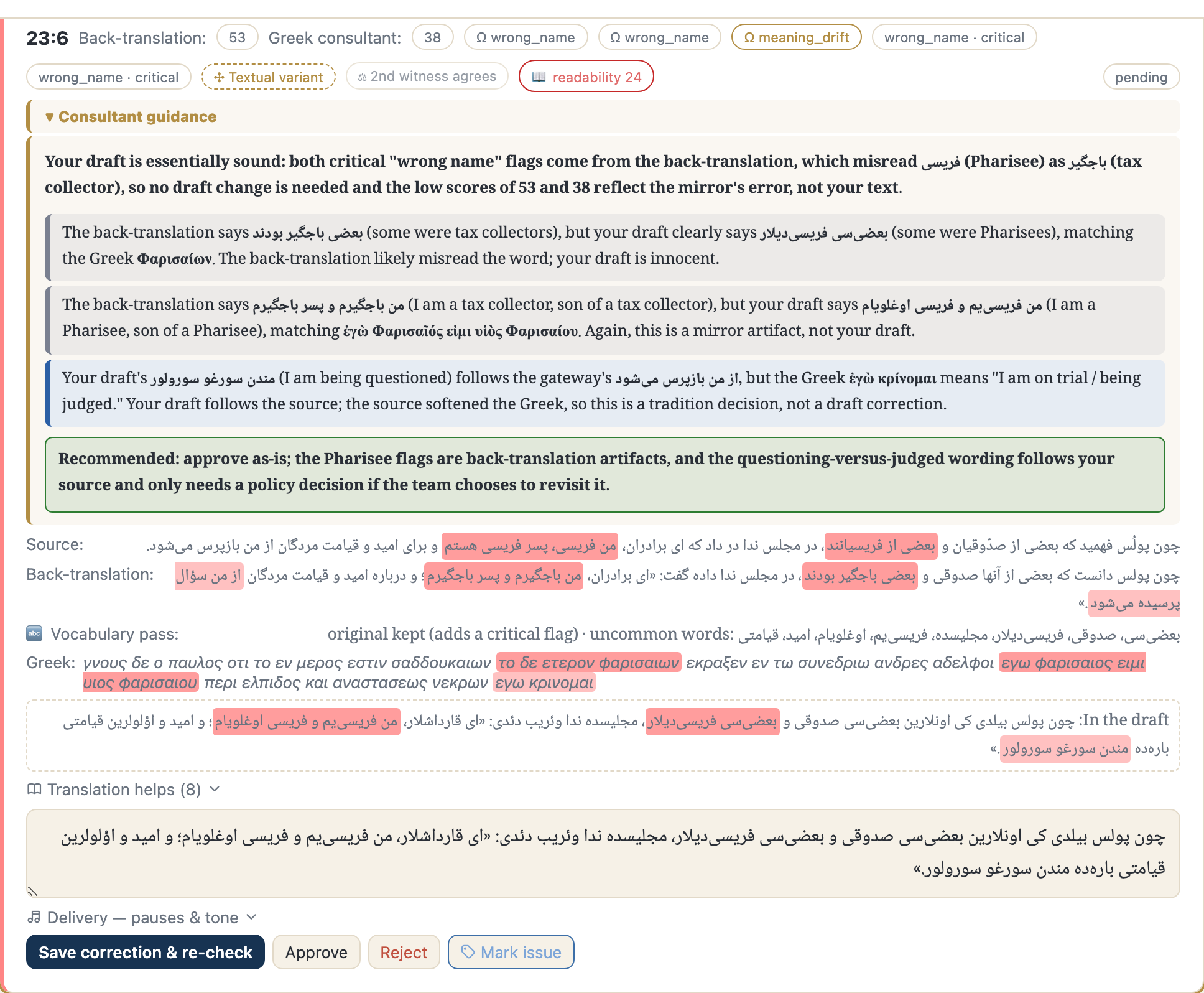
The jump: one click on a flagged verse opens the review screen on that chapter, scrolled to the verse and lit for a moment, with the flag's evidence marked on the back-translation and the original.
The same idea runs through the Key terms screen: the count next to each rendering opens every verse where the team's own text uses it, with the gateway verse under each, so a spelling decision is made on the verses, not on a number.
Checks: things the engine can find and fix
A page of checks on a text, each grounded, each ending in a person's decision. Nothing is written back to the team's files by itself.
Verse division
An older edition merged verses under one number and a team split them apart. This check finds every merged span, judges each split against the Greek or Hebrew of that verse number (the Hebrew re-numbered to the scheme the text follows), and proposes the corrected division using only the words already in the span. With no older edition it walks the whole text in windows instead. A person applies, edits, approves or dismisses each proposal; the export carries approved fixes only.
Spelling consistency
Every word of a language's text, the published corpus plus every approved verse, checked for spelling drift: forms that differ only in diacritics or letter shape, and never-seen words in unreviewed drafts one letter from an established one. Deterministic and instant, no model. The team ticks the forms it means and either matches them to one spelling across corpus and drafts, undoable, or records them as different words.
What a check is not
A check answers one question and stays inside it. Verse division never judges wording; spelling never judges meaning. A flag is a witness for the consultant, not a verdict, and the judge's stated confidence is a self-estimate until it has been measured against the consultant's own decisions.
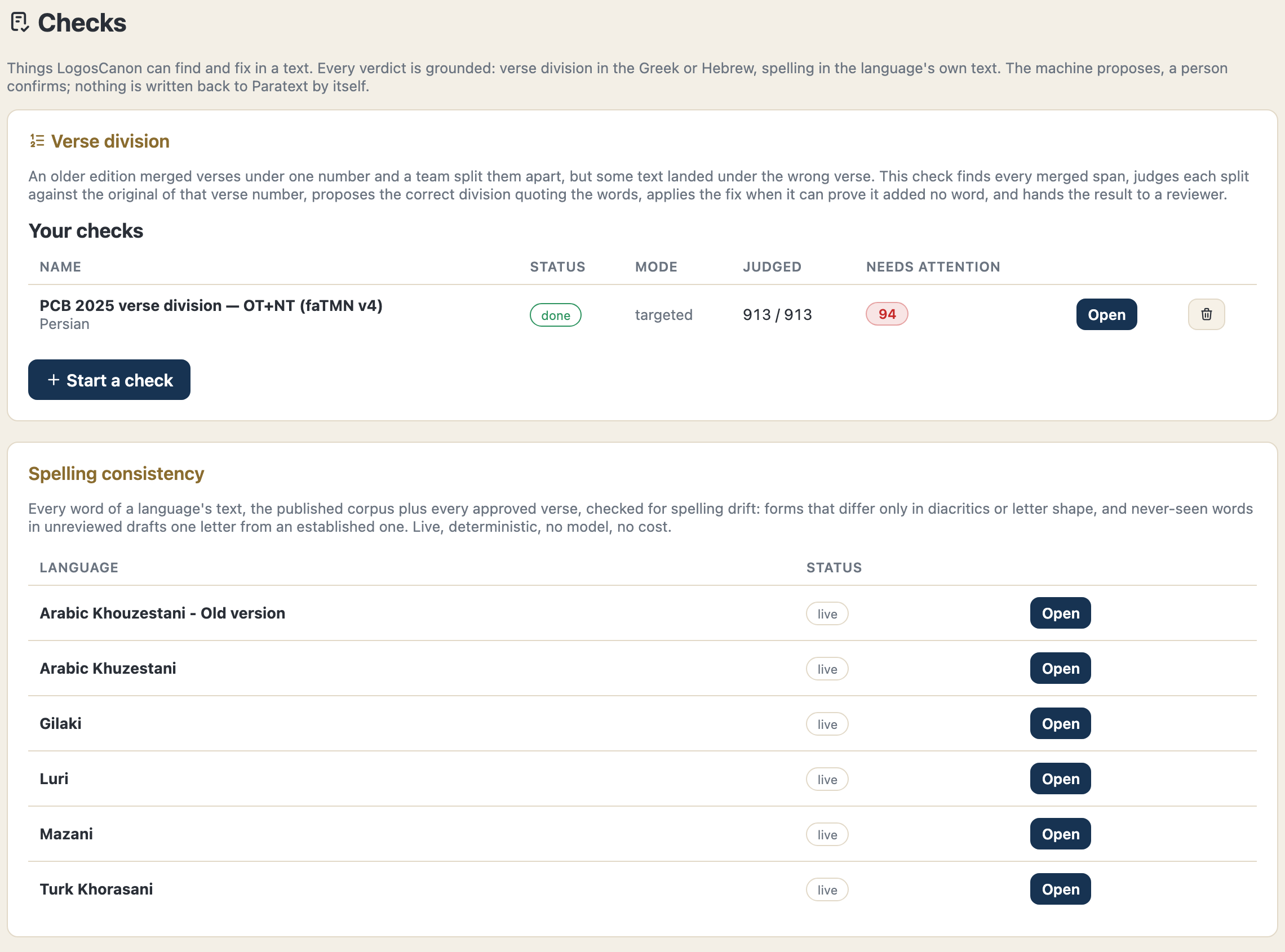
The Checks page. A verse-division check lists how many spans were judged and how many need a person. Below it, spelling consistency has one row per language; Open takes you to that language's own page, scanned on arrival.
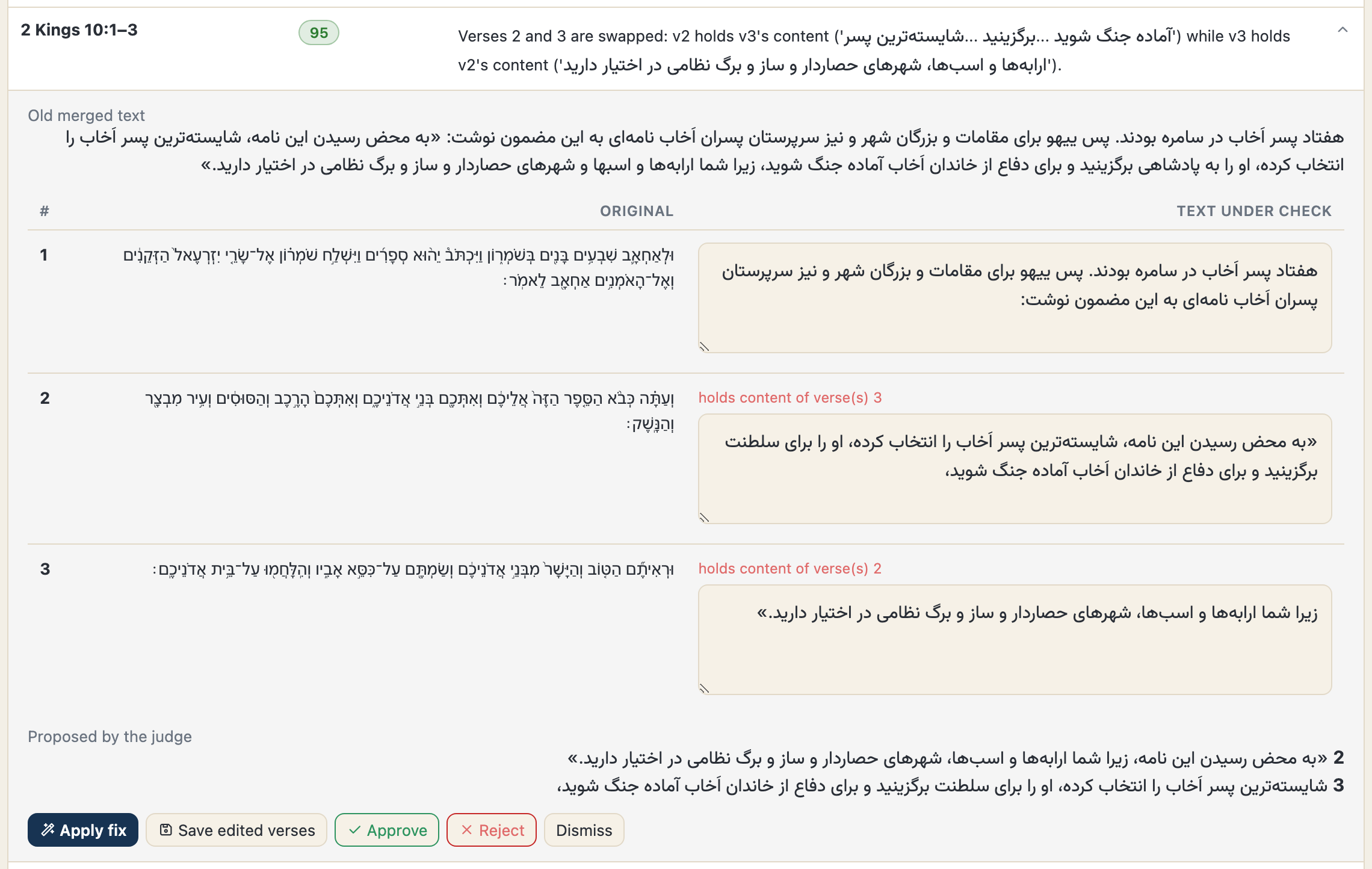
One span opened: 2 Kings 10:1-3, where verses 2 and 3 were swapped. The old merged text, then each verse number with the Hebrew of that number beside the text under check, the judge's proposed division built only from the span's own words, and the decision a person takes.
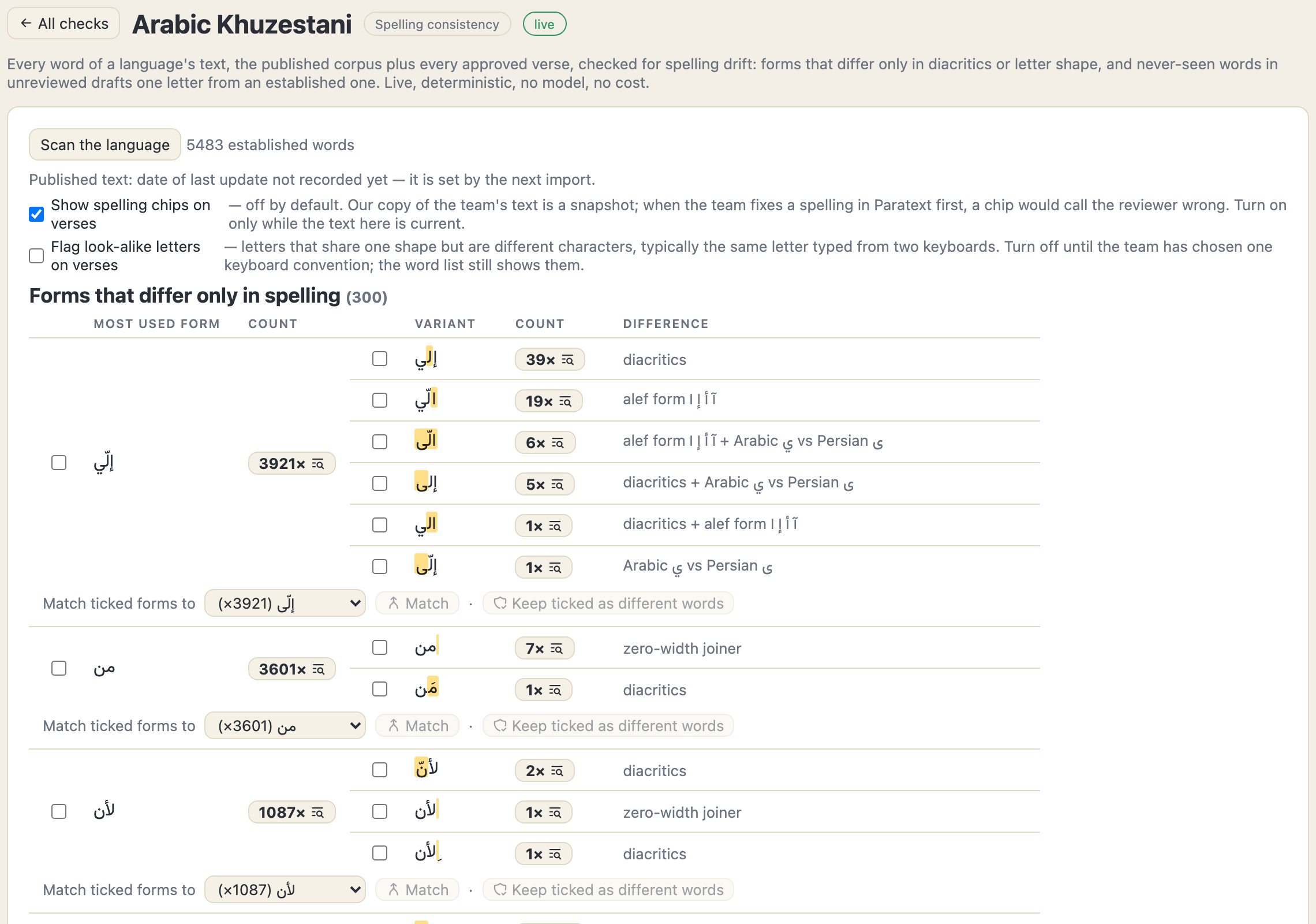
One language's spelling page. Each cluster shows the most used form, every variant with its count and what differs (diacritics, a joiner, a letter form, a look-alike letter), the highlighted stretch that differs, and a door from every count to the verses behind it. The team ticks forms and matches them to one spelling, or keeps them as different words.
For translation teams
Your team, your languages, your books, with the walls in the right places.
Roles that match the field
Owners and admins run the organization. Project managers get the file shuttle and USFM export. Reviewers see exactly their assigned language and review in the app.
Offline-first review
One HTML file carries a whole chapter to a reviewer with no connection. Their decisions import back with conflict protection and a full re-check of every correction.
Finishing a chapter
A chapter is finished when a mother-tongue reviewer has approved or corrected every verse; the review screen and the book page count the verses still waiting and open on them. Then an owner, admin or member confirms the text, which locks the chapter and makes it ready for export.
Consultant reports
After every re-check a report explains what changed and why, in the language each person reads. Reviewers receive it and project managers are copied by default.
Reports with their methodology
Every report carries its data attribution, the measured catch rates of the very checks that produced it, and how many verses each average rests on.
API included
A public /v1 API with per-organization keys, so drafting and checking can run from your own pipeline with the same per-verse evidence attached.
Language-agnostic by design
No language or script is hardcoded into any prompt or check. Orthography conventions are measured from the corpus itself, and the gateway language is configured per project.
Starting a language from nothing
Two tools for the hardest case: a language with little or no translated Scripture.
Survey a language
One search probes Glottolog, Unicode locale data, published Bible corpora, Door43, and the major speech and translation model catalogues, and reports what exists for the language before anyone commits to it.
Open Bible Stories as a starter corpus
For a language with no Scripture, its Open Bible Stories can seed drafting, clearly labelled as scaffolding. Measured before it was built: meaning carried within a point of Scripture-taught drafts against the Greek. Below 250 usable story frames the import warns hard, and as the team confirms real verses the stories phase themselves out.
What to upload first
The upload screen states the tiers plainly: one Gospel as the minimum, two to three Gospels or a Gospel with Acts and an epistle as good, the full New Testament as best. Which books make the strongest first corpus is a question we are measuring next, not one we claim to have answered.
Standing rules, enforced in code
Machine drafts are labelled MACHINE DRAFT, NOT SCRIPTURE on every report. No certificate is issued before mother-tongue reviewers confirm the text verse by verse. Nothing machine-made can enter an audit of a human translation. When a model declines to do a step, that step is left undone and marked, never routed around.